
My Card Post Auctions
Role
Design, Scope, Test
Project Duration
3 months
Date Launched
June 2025
What’s My Card Post?
My Card Post is a peer-to-peer trading card marketplace built to make buying and selling collectibles easier. Instead of charging fees on every transaction, it runs on a subscription model, which allows users to connect and make deals the same way they would at a card show. Because of this, we don’t limit communication on or off the platform, and we focus on building real relationships rather than keeping users anonymous.
My Card Post has grown to over 17,000 users and continues to gain traction in the hobby, recently earning the Best Marketplace Award powered by Yahoo Sports and Mantel.
The Problem
Before introducing auctions, My Card Post had already become one of the most flexible marketplaces in the hobby. Users could complete almost any type of deal you would expect at a card show, including multi-card deals, buy offers, and cash trades. However, there was still one major piece missing.
🚫 Limited visibility and fast liquidity for sellers
🚫 Sellers leaving MCP to list their cards for auction on other marketplaces, reducing overall platform value
🚫 Buyer retention for buying and sourcing inventory from MCP
🚫 Other auction platforms lack transparency and clear auction processes, creating an opportunity for MCP to stand out
The Goals
In April of 2025, I was given the green light to start designing and scoping our new auction format. From the start, we wanted to make sure the experience felt simple, fast, and aligned with how sellers already used My Card Post.
🎯 Allow sellers to easily convert existing listings into auctions in just a few seconds
🎯 Create dedicated pages and marketing focused specifically on auctions
🎯 Maintain our fee savings by offering auctions with no buyer premiums or extra costs
🎯 Keep auctions fast with 24 and 72 hour formats, while still allowing sellers to schedule listings ahead of time for better exposure
🎯 Keep buyers engaged with our auction offerings through marketing and reminder push notifications before an auction would end
The Outcome
After a few weeks of design work followed by about two months of development, auctions were ready to enter beta. Because auctions involve real money and real stakes, we had to be extremely careful about releasing anything before it was thoroughly tested. Sellers wanted to maximize value, bidders expected real time accuracy, and every part of the system needed to work reliably down to the second. Below are some of the key parts of the scope:
🎮 On the backend, auctions were built using Node.js with PM2 to handle real time bidding and ongoing auction activity. This setup allowed bids to be processed as they came in, including during the final seconds of an auction. PM2 was used to manage long running auction processes so timers, listings, and live updates continued running consistently as activity increased.
🎮 Implemented cron jobs to send push notifications, emails, and SMS reminders before auctions ended to give buyers every chance to place a bid and help maximize seller value
🎮 Added automatic time extensions so that if a bid is placed in the final 30 seconds, the auction extends by two minutes, giving other bidders time to respond and preventing rushed decisions
🎮 Allowed sellers to convert existing fixed price listings into auctions with a single click by selecting a date and starting price instead of having to relisting the card
🎮 Rolled auctions out as a limited beta with only a small group of sellers to ensure stability before a wider release
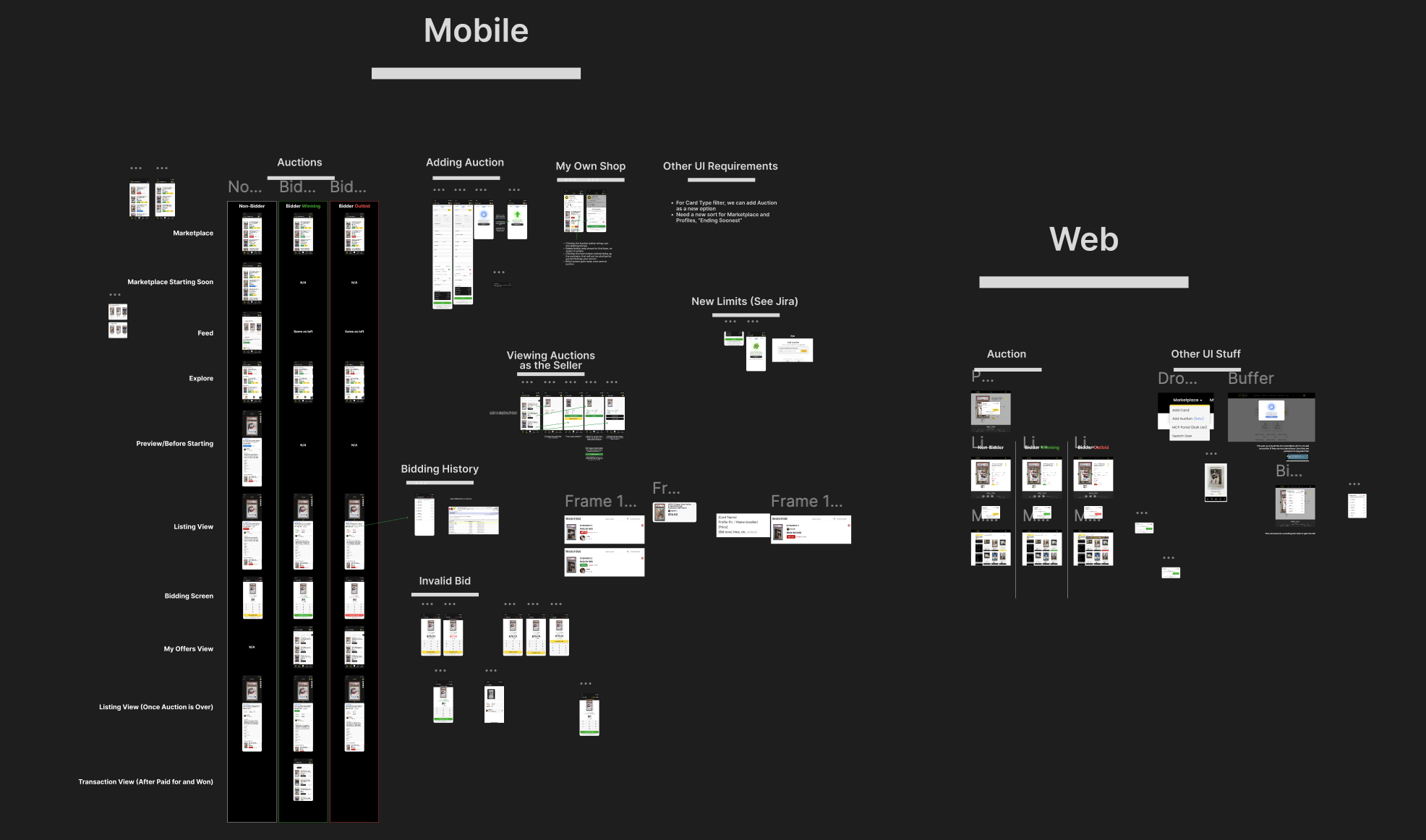
My Figma file (a little messy lol)
The Results
“I started running 3-day auctions consistently, timing them strategically. The auction format created urgency that fixed-price listings didn’t have. Instead of cards sitting for weeks with occasional price drops, auctions forced buyers to act. I’m seeing more and more followers engaging with my auctions and listings. It takes time, but the engagement is growing. One feature I love: if a card sits as a fixed-price listing and isn’t moving, you can easily send it to auction to try to get it sold and bring in some cash for your next purchase.”
✅ Since launching in June, auctions now make up 58% of all platform transactions
✅ On most days, there are 25 or more auctions ending across the platform
✅ Continued investment in auctions through dedicated pages, weekend events, notifications, and UI improvements
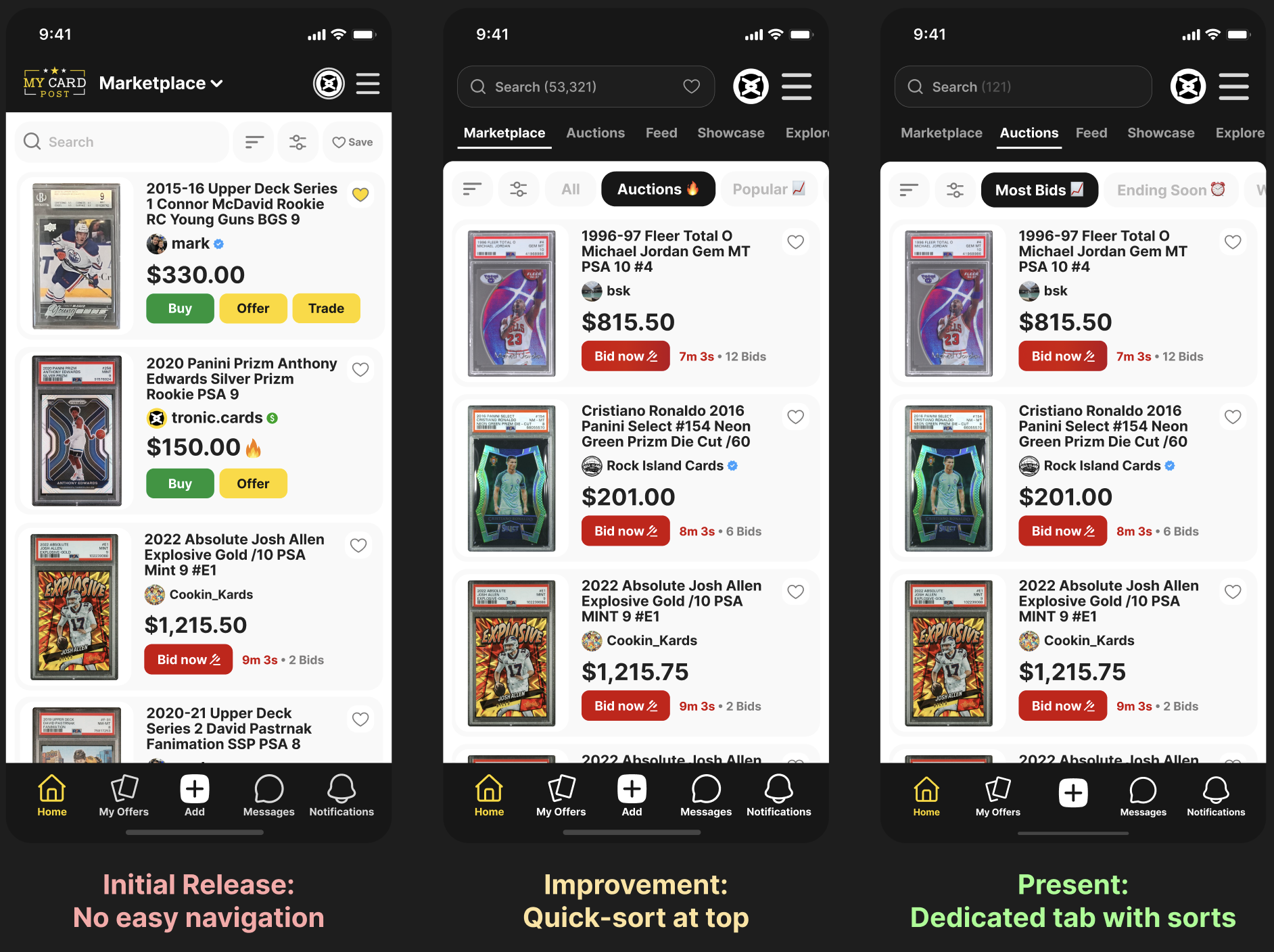
Oversight #1 - Navigation
On launch day, I quickly realized there was a major oversight. There was no clear or simple way to browse the marketplace specifically for auctions. Users had to dig through a hidden filter, which wasn’t obvious or intuitive. We had many users expressing their confusion this day.
This was on me. During testing, I was heavily focused on making sure bidding functionality worked correctly and assumed the design side was already solved. What I learned from this was that design doesn’t stop once something looks good on Figma. It carries through scoping, testing, and launch, and that lesson has directly shaped how I approach new projects since then.
Oversight #2 - Combined Shipping
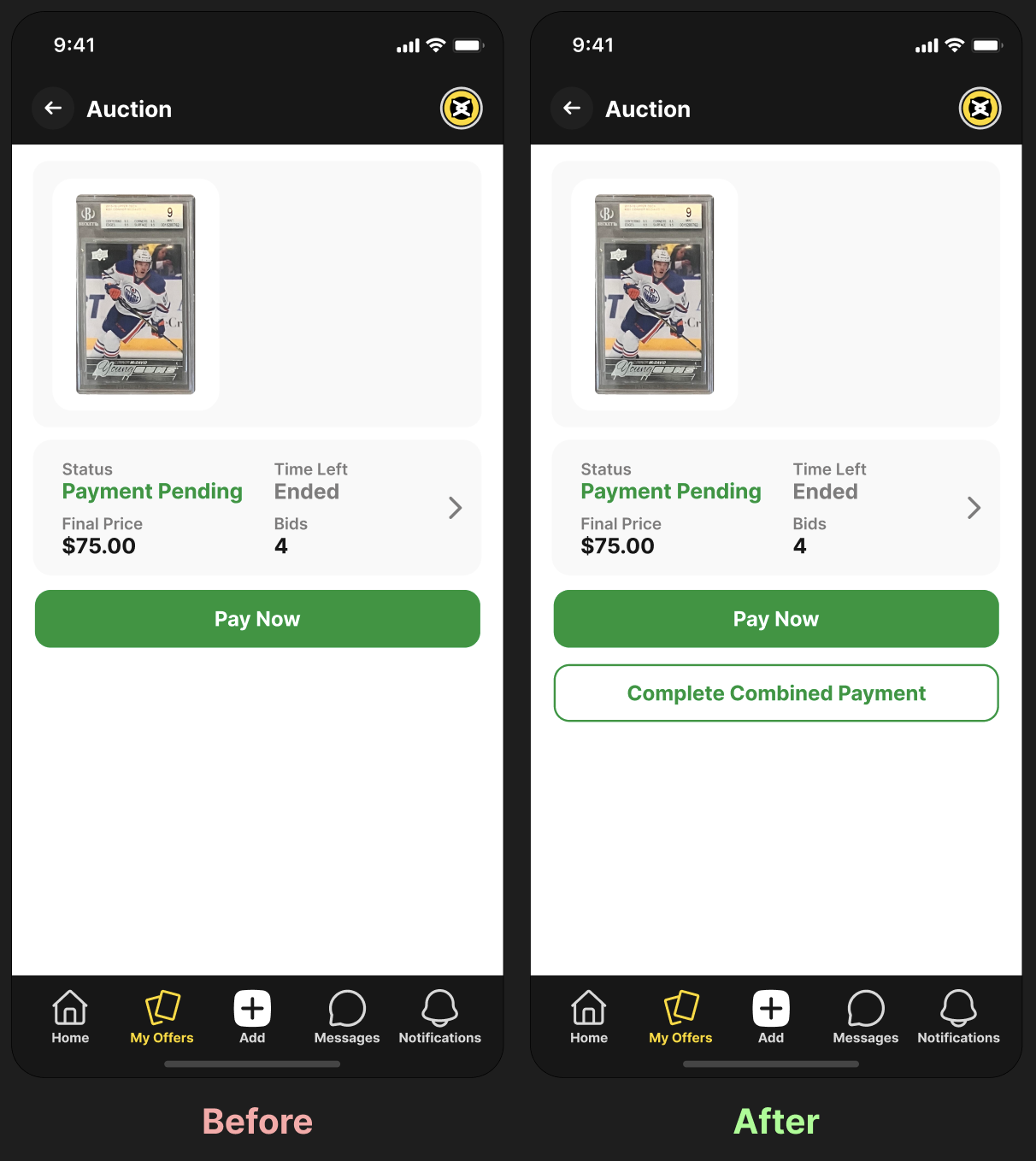
A week or two after launch, we started noticing a pattern where sellers were listing multiple auctions at once, often all ending on the same night. That meant buyers were sometimes winning several auctions from the same seller. When it came time to pay, buyers had to check out separately for each win, which could mean going through the checkout flow four or five times.
This was not just inconvenient. Paying separately also meant buyers were charged shipping multiple times, even though the cards would ship together. That led to refund requests, confusion, and extra work for buyers, sellers, and our team.
To fix this, we introduced a combined shipping option that lets buyers pay for all auction wins from the same seller in a single checkout. While there are still some limitations due to PayPal’s payments API, this change has already saved a lot of time and friction, and we plan to keep improving it.
Oversight #3 - Quality
During the mass rollout, we were excited to see how many sellers jumped in and started listing auctions. Not long after, we began noticing a pattern, along with feedback from the community. A large portion of auctions were either very low value, around $1 to $5, or had starting prices that were too high.
The low value auctions quickly cluttered the feed and didn’t add much value for buyers. We were able to mostly fix this by introducing auction limits based on subscription plans. The high starting price issue was harder. Sellers would list a $100 card starting at $90, which turned buyers away and defeated the point of an auction. We strongly encourage sellers to start auctions at $0.99 to build excitement and give buyers a real opportunity to engage.
To address this, we made several changes:
Implemented monthly auction limits by plan, 5 for Basic, 50 for Pro, and 250 for All Star, which also encouraged plan upgrades
Changed the Auctions tab sorting to Most Bids instead of Ending Soonest to surface the most engaging listings
Introduced auction events with minimum value requirements, such as $250 or higher
Educated sellers on the endowment effect and how lower starting prices can drive more interest and stronger final prices

Endowment effect social media post I put together
Oversight #4 - Non Payers
On My Card Post, like most auction platforms, buyers who win an auction are able to submit payment after the auction ends on their own time. Most of the time this works without any issues, but like all marketplaces, there are a few bad actors. Some buyers regret their win, get bid higher than they expected, or decide they no longer want the card and choose not to pay.
Many marketplaces allow buyers to walk away without real consequences, which creates a serious problem for auctions. To protect sellers, MCP introduced a three strike rule. Sellers can easily report non paying bidders, our team is notified, and we are able to take action by restricting those users from bidding in the future. Initially this was a manual process, but we autonomized it by allowing sellers to report within their transaction. Protecting sellers and maintaining trust in the auction system is a top priority.
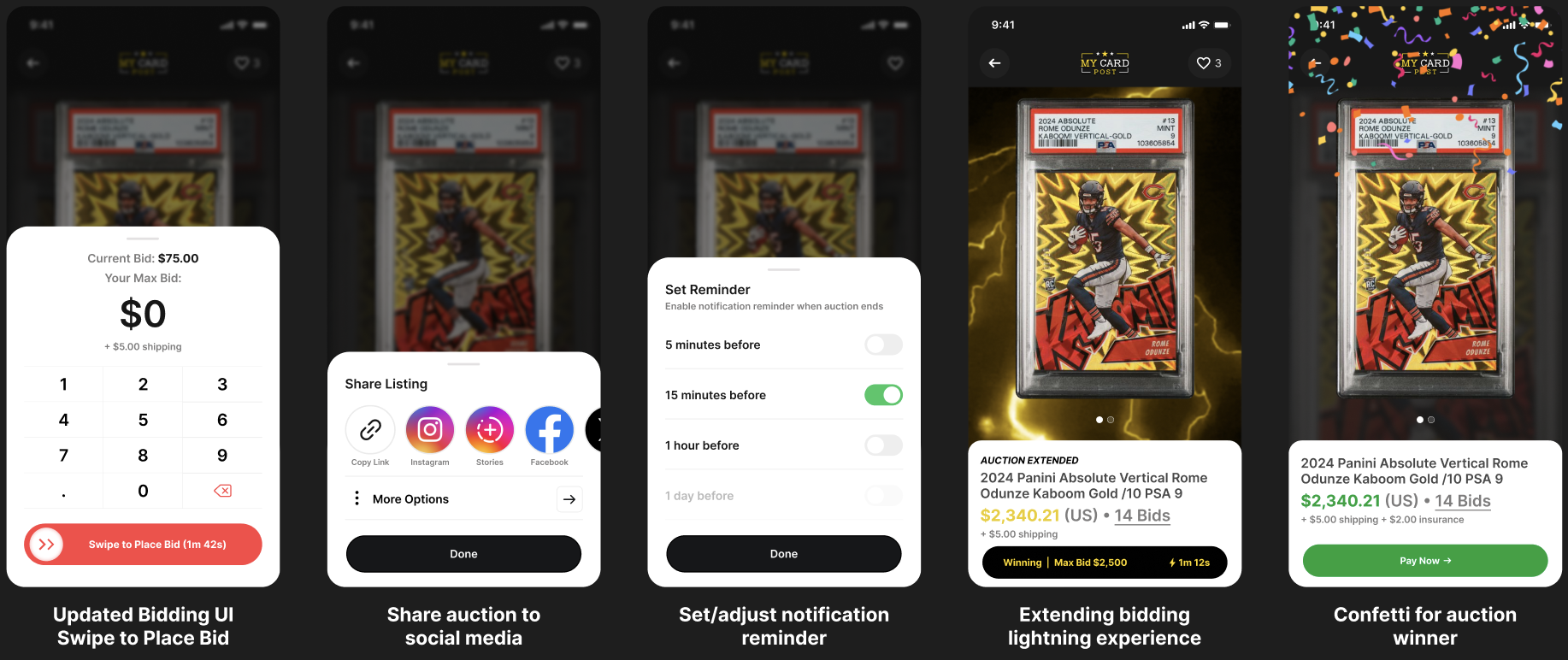
Oversight #5 - The Bidding Experience
When I first designed auctions for My Card Post, a lot of the work closely followed existing auction platforms like eBay, ALT, and Goldin. While this helped ensure familiarity, it also meant we lost some of the unique UI and personality that existed in other parts of the app.
That didn’t last long. After launch, we began introducing new auction experiences that felt much more aligned with MCP. The features shown below were all added post launch and helped bring back the identity and polish that makes the platform feel distinct.
The Crown Auction Event
About six months after launching auctions, we felt it was time for a refresh and a new marketing push. On December 8, I was looped into the idea for a campaign scheduled to launch January 8. That gave me 30 days to design, scope, build, test, and get everything approved by the app stores, all during the holiday season.
I jumped straight into design and after a few days of iterating and checking in with the team, we landed on a direction and got approval. For the developer scope, I used AI to clean up and structure my rough notes, which turned into a 25 page Google Doc that was ready to hand off. About 10 days later, the event was live on our staging app and site, which allowed us to run a full mock event and make sure everything worked as expected.
Some of the key features shipped with this event included:
A structured submission flow for sellers with eligible listings priced at $250 or higher, including a gold submit button and approval notifications
In app and website banners promoting the event and encouraging seller participation
Gold accents applied across the event UI and auction pages
A robust admin panel that allowed us to review submissions, reorder and stagger auction start times, manage banners and UI, and track event performance
Most importantly, the event was built to be fully repeatable without additional development, giving us the ability to set up and manage future auction events directly from our admin panel
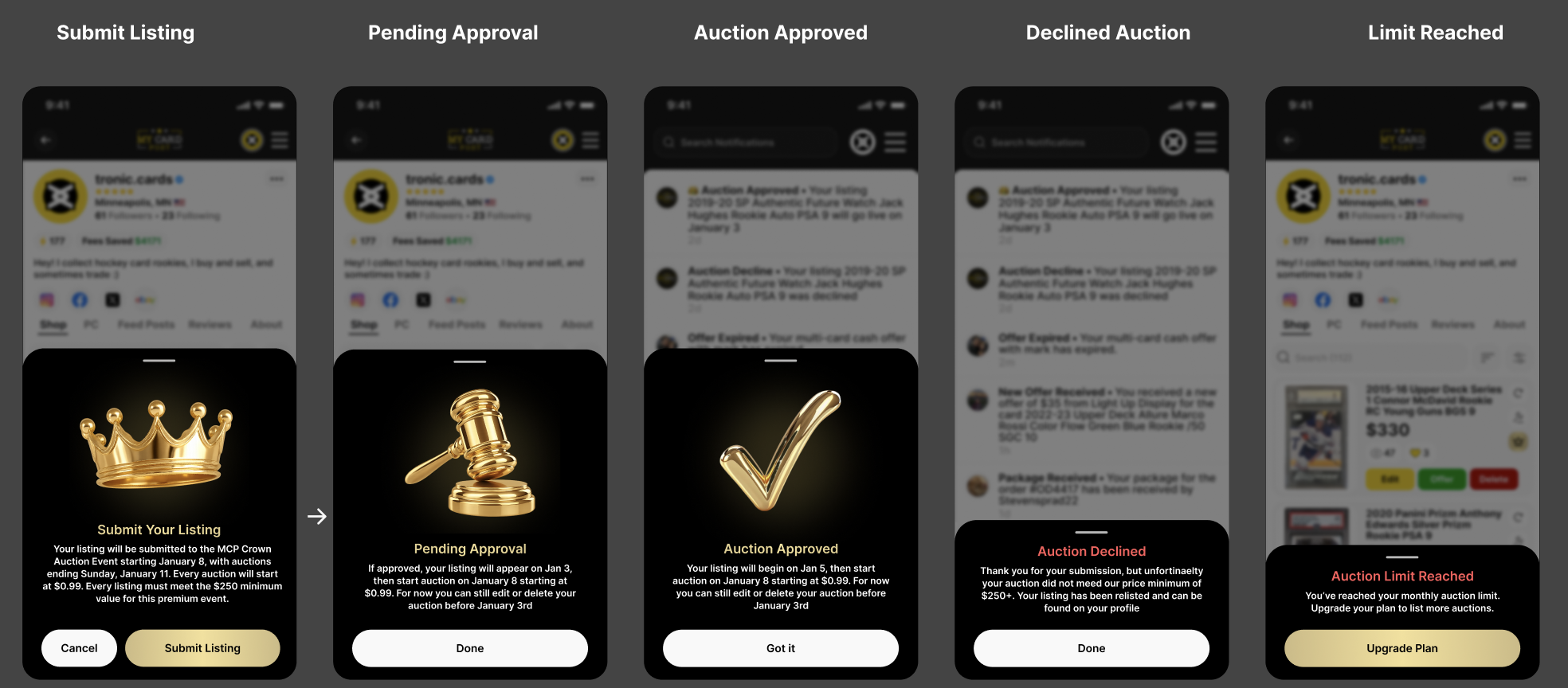
Submission process
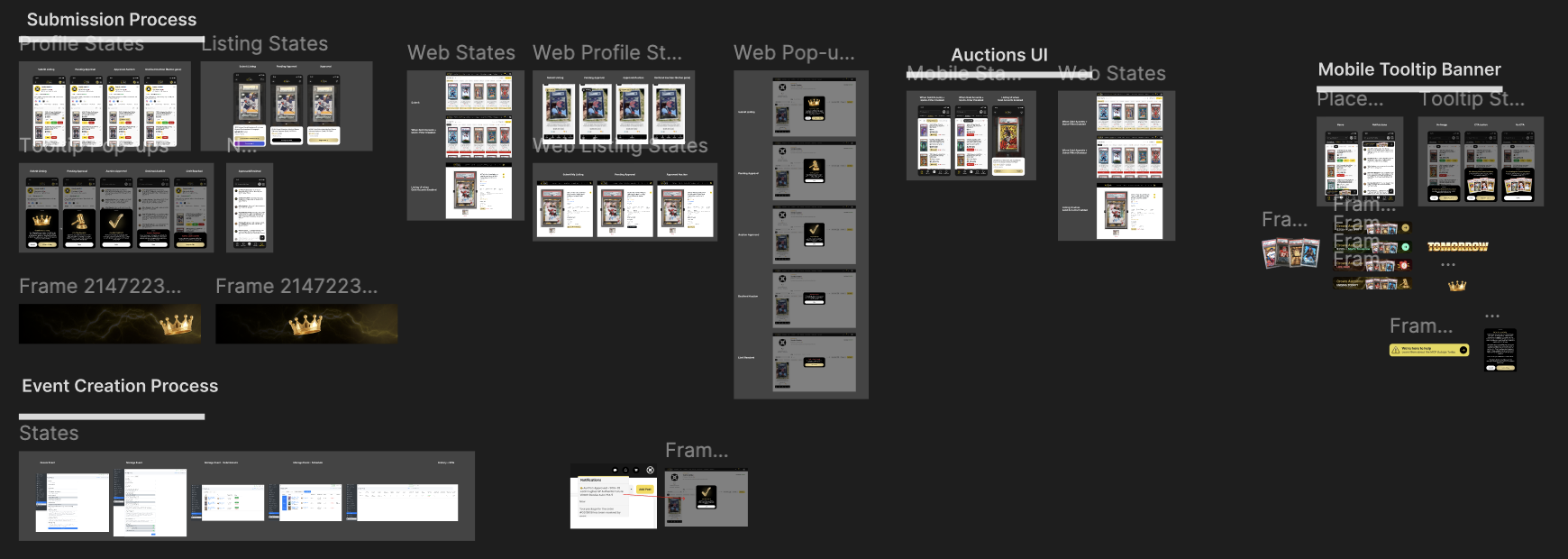
Figma file
After testing and approving all development, we pushed the update live to both the site and the App Store. The timing was tight due to New Year’s delays on Apple’s side, but once everything went live, submissions started coming in quickly.
Before launch, we had used a Google Form to collect early commitments for the event and received around 10 planned submissions from a small group of sellers. Once the app update was live, that number jumped to over 100 submissions from dozens of different sellers. It was a lot to manage, but also a strong signal that there was real demand.
After three days of bidding, here’s how the event played out:
✅ 100 total submissions, with 78 approved for the event from 33 unique sellers
✅ Over $15k in total sales across event auctions
✅ A 50% increase in daily active users during the three day event
✅ 1,500 plus total bids placed
✅ 165 unique bidders, with roughly 33% placing their first ever bid on My Card Post
✅ Approximately $1.5k in fee savings compared to fee based marketplaces
Overall, the event was a success. We avoided any major issues during the live auction window and surfaced a few smaller improvements that will help make future events even smoother.
Looking Ahead
We are excited to continue building on our early success with auctions. It is still very early, and we are focused on earning trust and building a strong reputation in the auction space. While many auction houses charge fees of 20 percent or more, MCP continues to operate with no transaction fees, which we believe is a huge value for auction based sales.
Looking ahead, we plan to keep running auction events and experiment with tying some of them to major moments like the Super Bowl or playoff runs. We also want to continue shaping a more unique auction experience on MCP by introducing new tools that improve transparency for bidders and help prevent foul play in a space where that is often a concern